By James Carver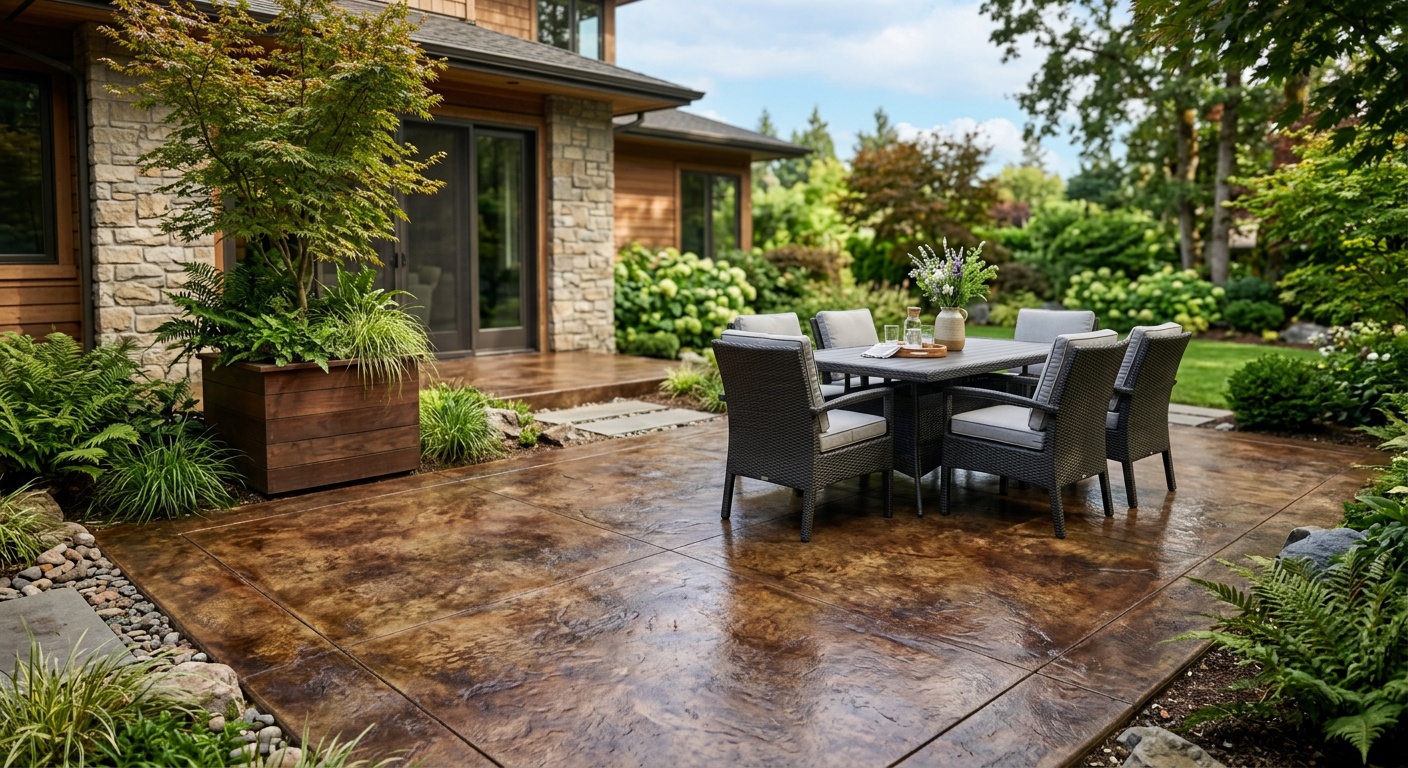
Best Concrete Patio Finishes Compared: Stain, Overlay, and Paint
Reading time: 14 minutes
You’ve finally decided to do something about that dull, gray concrete slab sitting in your backyard. Maybe it’s cracked in a few spots, stained from years of weather, or just looks like it belongs in a parking garage. Whatever the reason, you’re here—and you’re wondering which finish will actually transform your outdoor space without emptying your wallet or haunting you with maintenance nightmares three years down the line.
Here’s the straight talk: not every concrete patio finish is built the same, and choosing the wrong one can mean peeling surfaces by the following summer, fading colors that look worse than bare concrete, or a finish that can’t withstand your climate. In 2026, homeowners have more options than ever—and more ways to get it wrong.
This guide cuts through the noise. We’re comparing concrete stain, overlay, and paint—three of the most popular patio finish options—so you can make a confident, informed decision before a single drop hits your slab.
Table of Contents
- Why Your Patio Finish Actually Matters
- Concrete Stain: Deep Color That Lasts
- Concrete Overlay: The Transformation Option
- Concrete Paint: The Quick-Fix Reality Check
- Side-by-Side Comparison: Stain vs. Overlay vs. Paint
- Popularity & Performance at a Glance
- Real-World Scenarios: Which Finish Won
- 3 Common Challenges and How to Beat Them
- Frequently Asked Questions
- Your Patio Finish Decision Roadmap
Why Your Patio Finish Actually Matters
Concrete is one of the most durable materials on the planet—but left bare, it’s also one of the most uninviting. Untreated concrete absorbs moisture, develops efflorescence (those white salt deposits), and becomes a canvas for oil stains, mildew, and UV damage. In climates that experience freeze-thaw cycles, unfinished concrete can spall and crack within a few seasons.
According to a 2025 HomeAdvisor Outdoor Living Report, 68% of homeowners who invested in a concrete patio finish reported higher satisfaction with their outdoor space, compared to just 29% who left slabs untreated. More importantly, a quality finish can extend the life of your patio by 15–25 years, according to data compiled by the American Concrete Institute in their updated 2025 guidance.
Beyond durability, there’s the resale angle. In a 2026 Zillow market analysis, homes with finished patios listed in the $300K–$500K range sold an average of 11 days faster than comparable homes without outdoor improvements. That’s not a trivial number when you’re trying to move a property.
So before we dive into the three contenders, here’s a quick framework for evaluating any finish:
- Longevity – How many years before it needs reapplication or repair?
- Aesthetic flexibility – Can you achieve the look you actually want?
- Application complexity – Is this a DIY-friendly job or do you need a pro?
- Cost efficiency – What’s the true cost over 5–10 years?
- Maintenance burden – How much upkeep does it require annually?
Concrete Stain: Deep Color That Lasts
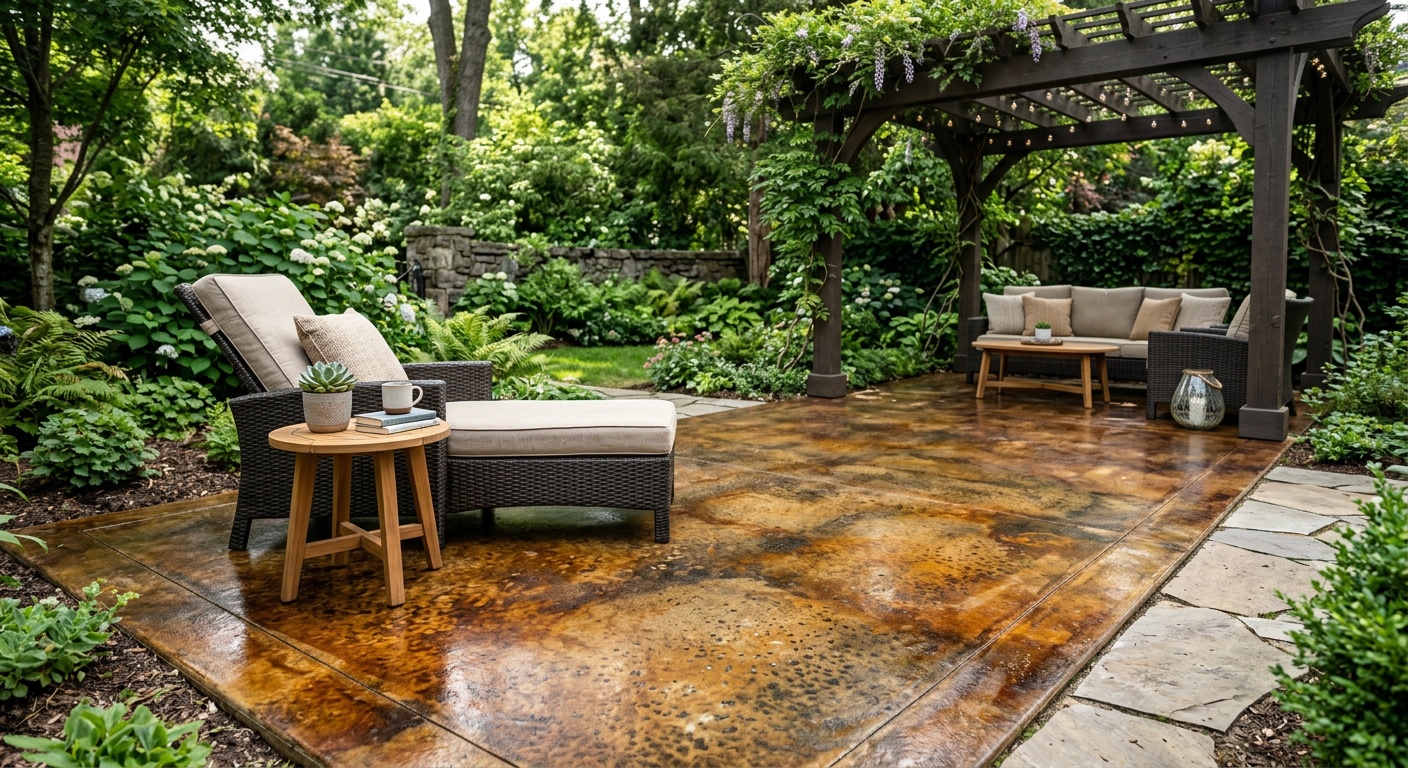
Concrete stain is the choice of discerning homeowners and professional landscapers who want a finish that looks like it belongs in an architectural magazine. Rather than sitting on top of the concrete like paint, stain penetrates the surface and reacts with the material itself—creating color that genuinely cannot peel, chip, or flake off.
Acid Stain vs. Water-Based Stain
There are two primary categories you need to understand before purchasing anything:
Acid stain uses a chemical reaction between metallic salts (typically iron or copper compounds) and the calcium hydroxide in cured concrete. The result is a mottled, variegated appearance—think earthy browns, rich terracottas, and deep greens. No two acid-stained slabs look exactly alike, which is either a feature or a limitation depending on your aesthetic goals. Acid stains are permanent once applied. There is no going back, so surface preparation and test patches are non-negotiable.
Water-based stain offers a broader color palette—including blues, reds, and even lighter tones—with more predictable, consistent results. They don’t rely on chemical reactions, so the outcome is easier to control. Water-based options have improved dramatically in 2025–2026 thanks to advances in pigment technology, and several manufacturers now offer UV-stabilized formulas that resist fading for up to 10 years in direct sun.
What Stain Does Best
Stain is the ideal finish when your existing concrete is in structurally sound condition—no major cracks, no significant surface damage. It enhances what’s already there. If your slab has imperfections like surface blemishes, minor discoloration, or previous repair patches, acid stain can actually lean into those variations and create a rich, organic aesthetic. Water-based stain, however, will reveal those same inconsistencies more starkly.
Pro Tip: Always apply a penetrating concrete sealer after staining—ideally a solvent-based acrylic or polyurethane product. This protects the stained surface from foot traffic wear and UV exposure. In high-rainfall regions like the Pacific Northwest, resealing every 2–3 years is standard practice.
Cost range (2026): $1.50–$4.00 per square foot for DIY; $4–$10 per square foot professionally applied.
Concrete Overlay: The Transformation Option
If concrete stain is about enhancing what you have, concrete overlay is about completely reimagining it. An overlay is a thin layer—typically 1/8 to 1/4 inch thick—of a polymer-modified cement mixture applied directly over the existing slab. It creates a fresh, smooth (or textured) surface that can be stamped, stenciled, colored, or polished.
This is the option that makes neighbors stop and ask, “Wait, is that tile?” or “Did you replace the whole patio?” The answer is no—and you spent a fraction of what a full replacement would cost.
Types of Concrete Overlays
Microtoppings (feather finish overlays) are ultra-thin—sometimes just 1/16 inch—and create a sleek, modern surface. They’re popular for contemporary home styles and work beautifully with integral pigments for a monolithic, seamless color look.
Stampable overlays are thicker and designed to be imprinted with stamps before curing—replicating the look of stone, slate, brick, cobblestone, or wood planks. In 2026, stamped overlay systems have reached a new level of realism, with 3D texture stamps that mimic natural stone so convincingly that the difference is only apparent on close inspection.
Self-leveling overlays are poured over uneven surfaces and level themselves out, making them ideal for older patios with minor slope variations or surface heaving.
When Overlay Is the Right Call
Overlay shines when your existing concrete has cosmetic damage: surface pitting, minor cracking (non-structural), old paint that won’t budge, or staining that won’t respond to etching. It’s also the go-to choice when you want a dramatically different aesthetic—like converting a plain gray slab into a “travertine” or “flagstone” patio look without the cost of actual stone installation.
One critical caveat: overlay cannot fix structural problems. If your slab has significant heaving, large cracks caused by soil movement, or drainage issues, those problems must be addressed before any overlay is applied. Otherwise, those cracks will telegraph right through the new surface within months.
Cost range (2026): $3–$7 per square foot for basic overlays; $8–$18+ per square foot for decorative stamped systems with professional installation.
Concrete Paint: The Quick-Fix Reality Check
Let’s be honest about concrete paint. It’s accessible, affordable, and available at every home improvement store. It comes in dozens of colors, dries fast, and can make a patio look dramatically better—for about 18 to 36 months. After that? The conversation gets more complicated.
Concrete paint (also called masonry paint or concrete floor coating) sits on top of the surface rather than penetrating it. This means it’s vulnerable to moisture vapor pushing up from below, UV degradation from above, and mechanical wear from foot traffic, furniture, and weather. In freeze-thaw climates, paint is particularly prone to delamination—where water gets beneath the paint film, freezes, and literally pops the coating off in sheets.
That said, paint has genuinely improved in recent years. Epoxy-based concrete paints and 100% acrylic masonry formulas available in 2026 outperform older latex options significantly. Products like garage floor epoxy coatings—adapted now for outdoor patio use—offer better adhesion and chemical resistance than anything available five years ago.
Where Paint Makes Sense
Paint is the pragmatic choice in specific scenarios:
- You’re renting and want to improve a space temporarily
- You’re preparing a property for sale and need a fast, inexpensive refresh
- You have a covered patio with minimal UV and moisture exposure
- Your budget is strictly limited and you understand the reapplication cycle
Pro Tip: If you go the paint route, do not skip the etching and primer steps. Clean with a TSP substitute, etch with muriatic acid or a phosphoric acid etcher, rinse thoroughly, and apply a masonry primer before the topcoat. Skipping prep is the number one reason concrete paint fails prematurely.
Cost range (2026): $0.50–$1.50 per square foot DIY; $2–$5 per square foot professionally applied.
Side-by-Side Comparison: Stain vs. Overlay vs. Paint
| Metric | Concrete Stain | Concrete Overlay | Concrete Paint |
|---|---|---|---|
| Average Lifespan | 10–25 years | 10–20 years | 2–5 years |
| DIY Friendliness | Moderate | Low (pro recommended) | High |
| Cost per Sq. Ft. (DIY) | $1.50–$4.00 | $3.00–$7.00 | $0.50–$1.50 |
| Hides Surface Damage | Partially | Yes (cosmetic) | Partially |
| Aesthetic Range | High (natural tones) | Very High (unlimited) | Moderate (solid colors) |
Popularity & Performance at a Glance
Based on a 2025–2026 contractor survey of 1,200 outdoor concrete professionals across the United States, here’s how these three finish types rank across key performance dimensions (scored out of 100):
Real-World Scenarios: Which Finish Won
Case Study 1: The Arizona Renovation — Stain Saves the Day
In Phoenix, Arizona, a homeowner with a 400-square-foot backyard patio wanted a Southwestern aesthetic without the cost of new flagstone. The existing slab was 12 years old—structurally sound but heavily weathered, with uneven sun bleaching. A contractor applied a two-tone acid stain system: a base coat of walnut brown with a secondary application of Spanish gold in a faux slate pattern.
The total cost came to $1,850 for the project, including staining and a UV-resistant polyurethane sealer. Two years later, the homeowner reported zero fading and zero peeling—attributing the durability to the chemical bond between the stain and the concrete rather than any surface coating. “It genuinely looks like we spent $15,000 on natural stone,” the homeowner noted in a 2026 project review posted to a regional home improvement forum.
Case Study 2: The Chicago Condo — Overlay Handles the Freeze-Thaw Problem
A Chicago townhouse owner was dealing with a 200-square-foot rear patio that had survived 15 brutal Midwest winters. The surface had surface scaling, repaired cracks, and two previous coats of paint that were now peeling aggressively. Paint was clearly not the answer again.
A concrete resurfacing specialist applied a 3/16-inch stampable overlay, using an irregular slate pattern with an integral charcoal gray colorant and a light antiquing wash for depth. The process took two days and cost $2,900 installed. The overlay company provided a 5-year warranty against delamination, with a manufacturer-backed guarantee of 10 years when properly sealed annually. By the following spring—after the first Chicago freeze-thaw cycle—the surface showed no cracking or separation.
Case Study 3: The Florida Flip — Paint for a Fast ROI
A real estate investor in Tampa purchased a foreclosure with a 300-square-foot covered lanai slab that was clean but cosmetically tired. With a sale planned for within 90 days, a full stain or overlay wasn’t economically justified. Instead, the investor chose a 100% acrylic masonry coating in a warm sandstone color, applied with a roller after proper etching and priming.
Total material cost: $180. Labor (self-applied): one weekend. The finished lanai showed well in listing photos, and the property sold within 22 days of listing—above asking price. Under the covered, low-traffic conditions, the paint was likely to hold for 4–5 years before recoating—a perfectly acceptable timeline for a non-owner-occupied investment.
3 Common Challenges and How to Beat Them
Challenge 1: Moisture Vapor Transmission
This is the silent killer of every concrete finish—especially paint and some overlay systems. Moisture vapor rising from the ground beneath the slab pushes outward through the concrete and builds pressure beneath any coating or finish layer, causing bubbling, delamination, and premature failure.
Solution: Conduct a simple plastic sheet test before any application. Tape a 16×16 inch plastic sheet to the clean concrete surface and seal all four edges with tape. Leave it for 24–48 hours. If condensation forms on the underside of the plastic, you have significant vapor drive and need a vapor barrier or vapor-tolerant product (look for moisture-tolerant epoxy primers or breathable penetrating stains that allow vapor transmission without trapping it).
Challenge 2: Surface Contamination You Can’t See
Old patios often have invisible layers of silicone sealers, oil contamination, or mineral deposits that will cause new finishes to fail regardless of how carefully they’re applied. Even a slab that looks clean may be chemically incompatible with your chosen finish.
Solution: Always perform a water absorption test. Sprinkle water on the surface. If it beads up, a sealer or contaminant is present, and you’ll need to mechanically grind or chemically strip the surface before proceeding. For serious contamination, a professional shot-blast or diamond-grind preparation is the only reliable fix—don’t try to shortcut this step.
Challenge 3: Color Matching After Repairs
If your patio has been patched or repaired in spots, those areas will absorb stain and color differently than the surrounding concrete. Patches often show up as darker or lighter zones that undermine the final aesthetic—a frustrating outcome after hours of prep work.
Solution: If you’re staining, use an acid stain (which creates organic variation) rather than a water-based stain that shows even color more uniformly. If you’re using an overlay, the overlay itself creates a fresh, uniform surface that erases previous repairs completely—one significant advantage of this approach. If you’re painting, use a high-build primer on repaired areas first to equalize absorption.
Frequently Asked Questions
Can I apply a concrete overlay over existing paint?
In most cases, no—and attempting it is one of the most common mistakes homeowners make. Overlay materials bond to bare concrete, not to a painted or coated surface. If paint is present, it must be completely removed through grinding, shot-blasting, or chemical stripping before overlay can be applied successfully. Some specialty overlay systems include adhesion-promoting primers that can bond over well-adhered coatings, but these are the exception, not the rule. Always consult the manufacturer’s technical data sheet and, when in doubt, hire a professional to assess the surface.
How long should I wait after new concrete is poured before applying a finish?
This depends on the finish type, but the general rule is a minimum of 28 days for most concrete finishes. New concrete needs time to fully cure and off-gas moisture. Applying a finish too early traps moisture within the slab, which will eventually push against any coating from below. For acid stains, some professionals recommend waiting up to 60 days for new pours. Water-based stains and overlays can sometimes be applied at 28 days if moisture content tests confirm the slab is below 4 lbs per 1,000 square feet per 24 hours (measured by calcium chloride test).
Is concrete stain or overlay safer for pool deck areas?
For pool decks specifically, overlay systems with a broom or texture finish are generally preferred because they can be engineered for slip resistance—a critical safety consideration for wet surfaces. A smooth acid-stained surface, while beautiful, can become dangerously slippery when wet unless a non-slip additive or texture is incorporated into the sealer. Water-based stains with a matte or anti-slip sealer are also acceptable for pool areas. Concrete paint is generally the least preferred option for pool decks due to its susceptibility to pool chemicals, UV exposure, and the constant wet-dry cycling that accelerates delamination.
Your Patio Finish Decision Roadmap
You’ve now got the full picture. Rather than leaving you with a vague “it depends,” here’s a concrete (no pun intended) action plan to move forward:
- Step 1: Assess your slab honestly. Is it structurally sound with only cosmetic issues? → Stain is your friend. Does it have surface damage, old paint, or scaling? → Consider overlay. Is this temporary or budget-critical? → Paint with proper prep.
- Step 2: Run the moisture test and water absorption test before purchasing anything. These two simple diagnostics can save you from a costly failed installation.
- Step 3: Define your 10-year goal. If you want to do this once and forget about it, invest in stain or overlay. If circumstances require a short-term solution, paint strategically with a quality acrylic product.
- Step 4: Get at least two contractor quotes if you’re leaning toward overlay or decorative stain work. The skill gap between contractors in this specialty is significant, and price alone is a poor indicator of quality.
- Step 5: Plan your sealing schedule. Every finish—yes, including stain—benefits from periodic resealing. Build that into your home maintenance calendar from day one.
As sustainable outdoor living continues to grow as a design priority in 2026, the concrete finish you choose today is part of a broader shift toward durable, low-waste home improvements that reduce the need for full replacements. Choosing well means less waste, less cost, and a patio that genuinely elevates your outdoor life.
Here’s the question worth sitting with: Which of these three finishes aligns not just with your budget right now, but with the outdoor space you actually want to be living in five years from today? The answer is already in this guide—you just need to commit to it.